Island Era – “The Body as structure”
“I believe in individuality.”
– Grace Jones
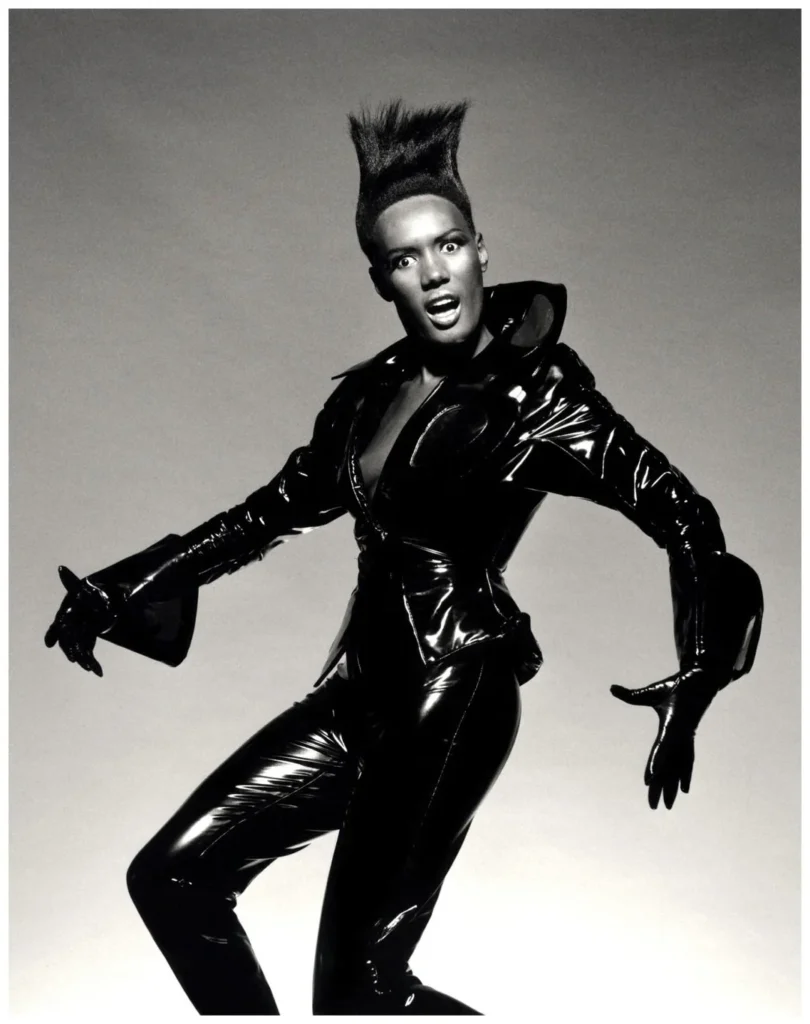
Grace Jones did not wear latex as costume. She constructed herself in it. During the Island era, the body ceased to be flesh and became form: angular, architectural, deliberate. Latex was not decoration; it was discipline. It tightened silhouette into structure, sharpened gesture into geometry, and transformed performance into sculpture. What emerged was not provocation, but precision.

In the Island era, Grace Jones did not flirt with fashion. She weaponised it.
The leather trench does not drape, it frames. It carves the body into a vertical line. Shoulder, waist, collar, blade. There is no softness here. No suggestion of compliance. The silhouette is deliberate, almost military in its restraint. Light strikes the leather and turns it metallic, armour, not adornment.
This was not sensuality in the traditional sense. It was authority.
Jones understood that latex and leather do not merely reflect light: they control it. In doing so, she controlled the gaze. The body became architectural: planes, angles, symmetry. The erotic was stripped of passivity and rebuilt as command.
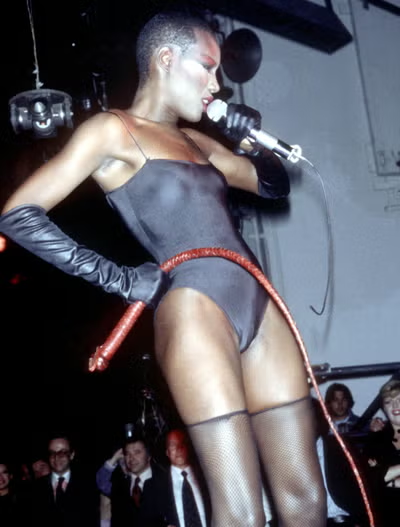
On stage, that architecture moved.
The bodysuit, cut high and severe, rejects the softness historically demanded of women in performance. The gloves elongate the arm into a weaponised line. The microphone becomes both instrument and phallic provocation: not submission, but dominance. She does not perform for the crowd. She performs at them.
Latex here dissolves gender boundary. The body is neither masculine nor feminine in the conventional sense; it is sculptural. It exaggerates strength. It emphasises bone, muscle, geometry. It refuses to collapse into softness.
In this era, Grace Jones did something radical: she redefined glamour as discipline.
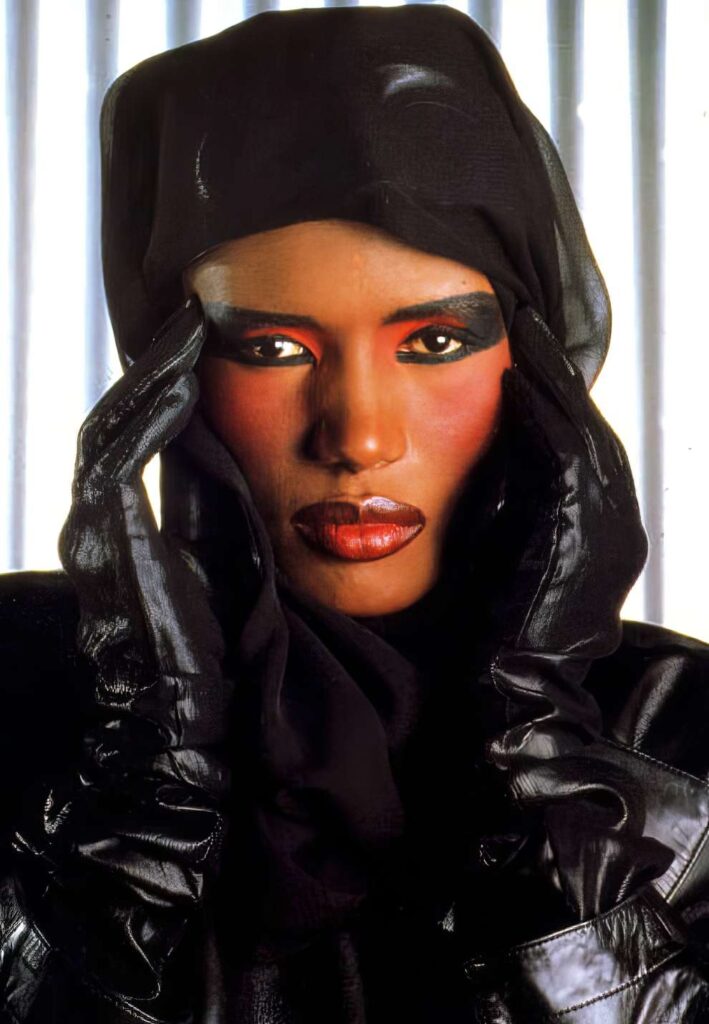
Grace Jones’ Island era is not nostalgia. It is blueprint.
In a culture that often mistakes exposure for power, she demonstrated that structure is power. That control is erotic. That identity is not inherited but engineered.
Latex was not costume. It was construction.
The body as structure remains her most enduring statement. A refusal to be fluid for comfort, a refusal to shrink for palatability. She stood angular in a world that preferred curves, sharp in a culture that preferred ease.
And in doing so, she did not merely wear latex.
She redefined it.